I.1 — THE CONQUEROR
He was seventeen years old the morning he learned what power was made of. He had assumed, until then, that it was the obvious things: the armour, the rank, the ten thousand men who would die on your word. He watched all three arrive on the road south that dawn, and by the third hour past noon he had watched all three fail to be the answer. It was the voice. Just the voice.
Edo smelled of sweat and copper that dawn. Under both of it, something else. Not fear yet. The thing that comes just before fear. The city had decided, in the night, that something terrible was coming.
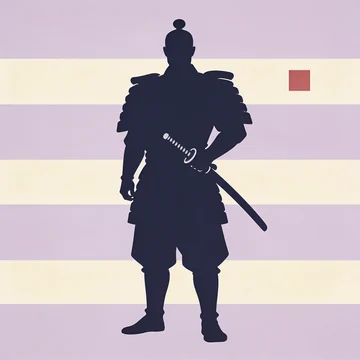
The boy, called Tenka by those who served under him and the Conqueror by those who will face him, stood on the eastern wall. Seventeen. Lean under black-and-gold armour that still looked borrowed on a frame not finished growing. His eyes burned an unhuman gold even in the morning light. He had already decided what he was, and found the rest of the world’s opinion on the subject mildly interesting at best. He stood with two dozen junior Samurai Masters soldiers and watched the road south resolve out of the bruise-yellow light.
Ten thousand men in Samurai Masters armour. At their head, a crest he knew: the lightning-bolt symbol of Ikazuchi, the Lightning Dictator. The man the whole camp had spent a month being furious about. His master’s political archenemy.
Tenka had never seen Ikazuchi in person. He knew the crest because he had studied it. Studying was what he did instead of being afraid.
He had spent fourteen months as a junior blade in the household guard of Nanado. The Six-Times General. White-haired, barrel-chested, a face so thoroughly scarred it had stopped looking damaged and started looking intentional. A man whose size said, on its own, that he had outlasted everyone who ever tried to stop him. In those fourteen months Tenka had stood at ceremonies and House of Daimyo sessions and once, for three hours, outside a Zen Masters bathhouse while his commanding officer conducted what he called a diplomatic meeting inside; the sounds through the wall made a detailed counterargument to the word. He had learned one thing in that time. The gap between what the Samurai Masters claimed to do and what they actually did was wide enough to march an army through.
Ikazuchi had been awarded the eastern campaign, and had already begun raising his war-host for it. Then Nanado went before the Lords and took it from him. Age had not diminished the old man’s hunger; it had calcified it into something indistinguishable from need.
The messengers sent to Ikazuchi’s camp that evening had not come back.
On the wall, the soldier beside Tenka was breathing in short quiet gasps through his mouth. Then the man wet himself. Tenka registered it with a quiet disappointment he could not have fully explained. The smell reached him before the man seemed to notice what he had done. Tenka looked at him, then looked away. He had expected fear. He had not expected this. The correct response to ten thousand men at your gates was simply not this. He filed the moment: know your men’s limits before you need them.
He checked himself for the same thing, the way you check a pocket in the dark, and did not find it. Not courage; he already distrusted men who used that word. The fear was simply kept somewhere he could not reach, behind a door he did not have the key to, and he had noticed by seventeen that other men seemed to carry theirs closer to hand. He had decided long ago that the difference did not trouble him. It troubled him a little now. He filed that too.
Then the army below reached the gates, and the question became irrelevant.
✦
The battle in the streets of Edo ran from dawn to the third hour past noon. It was not, in any useful sense, a battle. It was a destruction. Nanado’s forces came apart in front of Ikazuchi’s veterans with the efficiency of a thing that had been inevitable for weeks and was finally allowed to happen.
He came around a corner behind the canal district and was alone, his blade drawn, in front of a calligraphy school. Eight students watched him from a second-floor window. Solemn faces in a row. Old enough to understand what was happening. Not old enough to know what to do about it. He never learned what became of them. He thought about that window for the rest of his life, at intervals, without ever once being able to say what he wanted from the memory.
Tenka lost his unit in the first hour. Not to casualties. To confusion, which in street fighting was the more dangerous of the two.
He spent the next hours fighting his way south. Attached to no unit. Taking orders from no one. Working on the assumption that forward was correct until it proved otherwise.
The canal district’s streets were not built for armies. They were built for water and merchants, a city grown around its drainage rather than despite it: narrow passages, sudden turns, bridges one horse-width wide over channels that smelled of thirty years of city living. Ikazuchi’s soldiers moved through them the way disciplined men move through undisciplined ground, which is to say badly. Nanado’s remaining fighters used every alley and doorway and roof the district gave them, because it was their city and Ikazuchi’s veterans were temporary.
The streets had been built for the other trade the water brought, too. The canal quarter held Edo’s oldest pleasure houses, and on the morning of the sack they did not close. A pleasure house learns early that a war is only another kind of customer. So Tenka fought his way south past open screens and lantern-lit galleries where the district’s courtesans watched the killing with the professional stillness of women who had long ago priced every kind of man a war makes. In one upper window a girl in an unbelted robe leaned on the sill, her painted breasts bare to the cold, her chin on her hand, and watched him open a man’s throat in the lane below, and did not change her expression. She had seen the day’s ending before he had, and made the intelligent choice: wait upstairs for whichever army won, and would want, by nightfall, what she sold. He was seventeen. He did not stop. He remembered the window.
Three encounters found him in those hours. He fought two of them. The third he watched, and it was worth more than both.
The first was at the bridge over the second channel. Two of Ikazuchi’s ashigaru behind an overturned grain cart. They had war bows and a clean angle on the bridge approach, and they were good; they had already put an arrow through the throat of one of Nanado’s scouts, who lay face-down at the near end of the bridge with the fletching standing out of him like a reed. Tenka did not use the bridge. He went around the channel’s south bank, through twenty feet of shallow water that ruined his boots and answered their angle. He came up behind the cart. One of them heard him. The other did not.
The one who heard him was faster than expected. He had a short blade ready and came over the cart instead of around it, which was the unexpected choice, and the correct one. His cut opened Tenka’s left forearm to the muscle. The arm went hot before it went anything else, which nobody had warned him about and he never forgot. Tenka let the arm take it, stepped inside the man’s reach where a short blade is only a long knife, and drove his point up under the jaw into the skull. The killing thrust the manuals put on the last page and the alley puts on the first. It needs no strength. Only the willingness to be that close to a man while he stops. The archer folded over the point. Tenka held him up on it a moment and used the body for a shield, because the second man had turned.
The second man had a bow and no time. He reached for the short blade at his hip. Tenka let the first corpse drop, and in the motion that dropped it brought his blade across in a flat horizontal arc that opened the second man’s belly and the vessels behind it. That one did not die at once. They rarely do, from the belly. Tenka did not wait with him. Waiting was sentiment, and sentiment was for after.
He sat with his back against the cart for sixty seconds, breathing, watching his own forearm close through the bandage he pressed to it, and took the lesson under the lesson. The correct choice was always the unexpected choice, because the expected choices were the ones your opponent had already thought about. And the unexpected choice, in a narrow place, was almost always the closer, uglier one.
✦
The second was in the lane behind the dyers’. Three of Ikazuchi’s veterans, which were bad odds, except two were facing away and the third was experienced enough to know it. He took a proper stance and did the thing an experienced man does when the situation is genuinely bad. He talked, to buy his companions the time to turn around.
Tenka did not let them turn around. He took the nearer from behind, a short chopping cut to the back of the knee and the follow-through across the exposed nape before the leg had finished failing; left his blade in the second and used the pinned, screaming weight to foul the experienced man’s first stroke; then recovered it and finished the talker, who had been right about everything except how much time his talking had bought.
This was not how the military texts described honourable engagement. The military texts were written by men who did not often fight in narrow lanes behind dyers’ shops. He left the lane fast. Sound carried in the canal district, and there was a great deal of it behind him now.
The third was the one worth filing.
The Extreme Decapitating Air Waves. The old Samurai Masters manuals described it and no trainer ever used it, because it required the kind of absolute commitment that training taught you to suppress. He saw it used at the market gate. It was not what the manual had described.
The manual called it a philosophical technique. A state of perfect commitment, sword-arm and intention unified, producing a wave of compressed force ahead of the blade. It described the thing in terms of spirit cultivation and proper lineage. The manual was, as manuals generally are, completely correct about the result and completely useless about the method.
What he saw: a senior blade-master, one of Ikazuchi’s officers, at the market gate entrance, with five of Nanado’s men between him and the position he needed. Not a large man. Grey at the temples. A coat that had been expensive six hours ago. He stood very still for one breath.
Then he moved.
Three swings without pause, each one continuous with the last, the motion never stopping, only redirecting, and the compressed air off each cut arrived before the blade did. A gust would have been nothing like it, and neither would wind. This was concentrated pressure, a column of displaced force moving at the speed of the swing, reaching the body in its path a fraction of a second before the steel would have. The first man dropped without being cut. The second dropped without being cut. They hit the ground as if something had simply removed the principle that held them upright.
The third took the blade itself.
The fourth and fifth saw what had happened to the first three and made the calculation sensible people make.
The five were Nanado’s men. His own side, in the loose sense that Tenka still had a side. He watched three of them die in the space of a breath and did not move to help. There was nothing in helping them but dying beside them. And, he noticed this about himself with the cold clarity he was already learning to keep off his face, the part of him that should have wanted to was busy. It was watching the officer.
The quality of the stillness before the motion. The moment of commitment that did not look like commitment, that looked like nothing, that looked like a man simply stopping, and then the technique arriving as consequence rather than effort. He memorised every detail with the exactness he kept for things he meant to master completely, and filed it: under later. Something moved in his chest that he had no word for and he did not go looking for one.
He was seventeen years old. He had two cuts on his left forearm and mud on both legs and he had just watched a man clear a gate with an application of force that was not, by his understanding of physics, possible.
He updated his understanding of physics.
He stood in the market gate with two cuts in his arm, and a want arrived in him, clean and total, and it frightened the fear he had failed all morning to find. He wanted to be the man who did that. Not the officer. The thing the officer had briefly been: the exception to the rule of what a body could do to a street. He had wanted things before, the ordinary way. This was not that. This was the shape the rest of his life would take, arriving all at once, in a market gate, before he had a word for it.
He was three streets away, close enough to hear it, when Nanado’s command structure collapsed. What came next became a story people told about Nanado for the rest of Edo’s history.
✦
The six-time Commander Nanado was found in a drainage ditch below the eastern ward. Stripped of his armour during his attempt to escape the city. Crouched in the reeds with cold water to his chest and canal mud to his elbows. He had been there perhaps twenty minutes. The scouts who found him, Ikazuchi’s advance men moving through the collapsed Nanado positions, did not know him at first, because the man the Samurai Masters world knew was enormous and armoured and six times victorious, and this creature in the mud was old and naked and shivering. The scar identified him. Four parallel lines across the neck, from a blade that had nearly taken his throat in his third campaign. Every veteran in the Samurai Masters knew that scar.
The story moved through both armies like fire through dry paper. The Commander. In a swamp. Naked.
We are raised inside a bargain. A man is given rank, and land, and the right to be obeyed, and in exchange he is required to be, at every hour and in front of everybody, the thing his rank says he is. Not to feel it. To be it, visibly, and most of all when it costs him. The bargain is not truly with his lords. It is with the men standing below him, and it is the only reason any of them hold a line that is losing. Break it once, in public, and there is nothing underneath. Not disgrace, which is a bruise. Haji, the old word, which does not translate to shame, shame being private and survivable. It is nearer to a debt called in. And a man in that condition has, by our tradition, exactly one instrument left with which to pay it, and every soldier standing in that street had known what the instrument was since he was a boy on a practice floor. That is what fell over the canal quarter when the story reached it. Not pity, and not the comedy of the thing. It was ten thousand men standing still in a burning city, waiting to find out whether a legend was going to pay.
For exactly forty-three breaths, and Tenka read every one of them the way he read any room he meant one day to hold, the battle stopped.
And then Nanado, six times a general, proved that he had not survived six campaigns by being the kind of man who stays in a drainage ditch. He backed up ten steps when he saw an opportunity.
A lamp appeared.
It appeared in the upper window of an abandoned merchant house over the canal. A house with paper screens and one quirk of its build: the second-floor window faced south, directly above the largest knot of frozen soldiers.
A panel of white silk caught the light.
The silhouette it threw against the southern wall was not the silhouette of a man just pulled from canal mud. It was enormous. A vast paper shadow at full height, the bulk of old campaign muscle legible even in the flat geometry of shadow on silk: the breadth of the shoulders, the weight of a man who had worn armour since his twenties and kept its shape without it. The lamp was angled perfectly. The lamp had been placed by someone who understood stages. Nanado only had to understand how to use one.
Every soldier in sight of it saw it.
In the silence between the lamp appearing and the voice starting, every man in the canal quarter saw two things at once: the naked shivering old man in the mud, and the enormous shadow standing at the height of a god. Their minds did what minds do with two truths that will not reconcile. They chose the larger one.
“MY NAME,” said the voice, not the old man’s creak, not the reed-choked rasp of a person who had just swallowed canal water, but a voice like a war drum striking something hollow in the chest, the voice of the silhouette rather than the man who cast it, the voice of forty years of command condensed into a single register that rolled down the canal and came back off the far wall as its own echo — “IS NANADO.”
The shadow grew as it spoke. Until it covered the whole southern wall, shoulders spanning house to house, a black giant looking down on the small armoured men in the street. A trick of the lamp; a step toward the light; no magic needed just stage craft. Every artist will tell you that a great performance is indistinguishable from magic in the eye of the audience, and it costs much less.
“My name is Nanado,” it said again, quieter now, which was worse, “six times the saviour of Edo. Six times this city has stood in the fire, and six times I have carried it out on my back while better-born men wrote poems about the smoke.”
“My name is Nanado. I have fought demons in the drowned provinces and spirits on the black passes and things that have no name in any tongue you were taught — I fought them in the dark, alone, bleeding, while you, the bravest of you, were still soiling your swaddling and screaming for your mothers. My name is Nanado, and my shadow throws more light than Ikazuchi’s whole army throws steel. Look at it. You are standing in it now. You have been standing in it your entire small lives, and you never once looked up until tonight.”
Then it came, not louder but wider, filling the quarter the way thunder fills a valley, a sound that reached the chest before it reached the ears:
“SO WHO, who among you, in the mud, in the dark, with your borrowed courage and your stolen orders — WHO ARE YOU, to raise a blade against the one true hero of Edo?”
The shadow’s arm rose and swept the whole street, every frozen blade of them, the gesture of a man counting insects.
“Step forward, then. Whichever of you wishes to be remembered for one thing only, forever. History is standing at the end of this street. She has an excellent memory. And she has never once written the name of the man who murdered a legend in a ditch — except to spit it.”
No one stepped forward.
The silence that followed was the loudest thing Tenka had ever heard.
✦
Nanado did not pay. He did a thing no manual in this Realm has a name for: he threw a shadow onto a paper screen and settled the account with his voice instead, and it worked, that night, on that street, which was the only night it ever had to work. A boy of seventeen watched from a wall while a man bought his way out of the one debt our whole order insists cannot be bought out of and built a life on it. I have wondered, across fifty years, whether this Realm would have been better served if the reeds had produced a body.
He was close enough to see the exact moment it moved through the nearest knot of Ikazuchi’s soldiers. The shift in posture. The hands that tightened, then loosened, then did not know what to do. These were veterans. Men who had been angry for weeks about Nanado stealing their campaign, whose anger had just been vindicated by everything they had seen that day. And still they hesitated.
Not all of them. Not for long.
But long enough.
The lamp went out. The shadow was gone. And in the dark it left, the old man moved.
He came down through the merchant house the way water finds its way down through rock: finding the open path, moving without sound, spending every street-fighter’s trick forty years of war had left in his muscle. No armour. No weapon. Canal mud in his hair and his dignity split about evenly between the ditch and the silk on the wall. None of it slowed him. He went through the canal quarter’s warrens the way the warrens were built to be gone through, unseen and untraceable, the oldest neighbourhood in Edo closing behind him like water over a stone.
He was gone before the hesitation ended.
Tenka stood in the canal quarter with canal mud on his boots and thought about what he had watched. He had fought better than anyone on that wall that day. Better than men twice his age. Better than officers with names and campaigns and opinions of their own weight. He knew it with the plainness he had already learned to keep off his face, because other people found it unsettling. It did not unsettle him. If anything, he was waiting for the world to catch up.
What had stopped him cold was not the escape. Anyone can escape, given a city full of exits and a moment of confusion. He was thinking about the voice. The weaponised certainty of it. The way it had turned a man hiding naked in a swamp into a presence that made trained soldiers flinch.
He was seventeen years old and he had just learned the most important thing he would ever know. He already had position. Armour. Skill, planning, the habit of being right. He had watched all of it, that morning, fail to save the man who held it in greater measure than anyone alive; and he had watched one thing succeed, out of a ditch, with none of the rest to stand on.
It was the utter refusal to be anything other than what you had decided to be.
He filed it, with the care he kept for things he meant to master completely.
He would use it until the day he died. And he would be better at it than Nanado ever was, because he would not need a drainage ditch first.
I.2 — THE ACTOR
Ren of the Hana-za theatre company had been on the calligraphy-school rooftop since before dawn. He was a great actor and an even greater stage director and was paid handsomely for both. He had spent nine years learning that the pay was the smallest thing the work was for.
The lamp in the merchant house below, the silk panel, the exact angle of the window, the house itself chosen two weeks earlier for the one clean sight-line it kept over the canal, was his. He had set it in the dark, before the first of Ikazuchi’s columns reached the eastern gate, before Nanado’s line began to fail, before any of it was certain to anyone but him.
That was the whole difference between directing and performing. You build the stage before the actors arrive, and then you trust the scene to want what you have already decided it wants.
Aratake sat beside him against the parapet, knees drawn up, watching the streets below the way he watched everything: complete attention, and no apparent need for the watching to become anything else. He had been with the company nine years, hired in a city Ren no longer named, and had stopped asking him to explain things some eight years before, after the third time the explanation proved unnecessary because watching had been enough.
The battle itself was dramatically uninteresting. Street fighting always is. If you ever thought men were intelligent, watch what they would do with each other in dark alleys, when no one sees them.
What was interesting was the shape the silence would take when the fighting stopped.
Ren had assigned the role three days earlier, from the archive of the company’s oldest texts, where the Swamp King play script slept in its scroll case at the back of the third shelf: an ancient Hana-za comedy, a man stripped of everything who wins it back by the force of a single performance. Humiliation is not defeat. Defeat is the moment you believe the humiliation. He had set the lamp for a stage. He had chosen the play. He had given Nanado the part. What the old man did with it was the old man’s to do.
It has one line worth keeping and the whole cycle is built to arrive at it. The Swamp King, pulled out of the water, stripped, laughed at, with nothing on him and nothing behind him, is asked by the man who took everything what he imagines he still has.
My voice. You did not think to ask for it, and I have never been in the habit of offering.
Ren had directed the scene perhaps a dozen times across his career, always from the wings.
He watched the lamp take light.
He watched the silk take the lamp.
He watched the voice go down into the street.
He watched forty-three beats of complete silence pass, a director keeps the length of a pause the way other men keep a pulse, and then the hesitation moving through Ikazuchi’s veterans like a current through standing water.
In the notebook that I would find years later: The man still knows how to use a stage. Kept, for later: Useful. Dangerous.
✦
Hold the account there a moment, on the rooftop, with the lamp still burning in the window below and the old general already slipping down into the dark of the merchant house, because you cannot understand what you have just watched until you understand the man who built it.
There is a kind of man who has never, in anyone’s memory, broken character, and after long enough in his company you stop being certain there is a character underneath to break. Ren was that kind of man. The Author of Unwilling Roles, the company called him, half in affection and half as people name a thing to make it a size they can hold. He had carried the Hana-za Travelling Theatre Company through three wars in robes of dark navy worn to the softness of much-handled silk, and he was ageless as certain very old and very patient things are ageless, and he watched every room he walked into the way a director watches a rehearsal: waiting, without impatience, for the moment the performance forgets it is one and becomes, for a breath, true.
No one knew where he had come from. The story, worn smooth from retelling, ran that he had walked onto a stage in Keimachi in the middle of a scene, taken the villain’s part without a single missed cue as though he had been rehearsing it a year, bowed to a cast too astonished to stop him, and then simply been there when the company packed for the next city. No contract. No introduction. No history offered, and, after the first evening, none asked. Twenty years on, no one in the Hana-za could say who had hired him, and every one of them was privately, immovably certain it had been somebody else.
He had been fourteen the first time he gave a person in his life a role out of a play, quietly, the way you find yourself humming a tune you cannot put down, and watched, across the following weeks, the person become it. He told himself it was coincidence. He told himself so for a year. Then he stopped telling himself things and started being careful instead.
He never once said the gift aloud, and I will not pretend to more certainty about it than he allowed himself. This much is in the notebook, in his own hand: that when he assigned a person a role, not aloud, never aloud, but in the private book of his mind where he kept his productions, the role rose in them the way a current rises in deep water. Invisible from the surface. Undeniable to anything swimming in it. It rose slowly, and it did not stay risen, and it did not ask the person’s leave.
It had rules, the way tides have rules, and the first of them was not a prohibition but a price. He could assign a part to anyone. It could be hung on empty air, on a person it fitted nowhere at all, if a man were willing to pay what that costs; and Ren had worked out what it costs a long time ago, and had spent the years since declining, almost always, to pay it. A part that fitted something already in the person came very nearly free. A part that fitted nothing came out of the wearer and out of the tailor, in that order, and there is no third party to bill. He could not afford to make a coward brave. He could make a brave man understand, at last, what his bravery had been for, and that cost him almost nothing, and it is the more dangerous of the two things to hand a man. The roles he had learned to fear were the ones that asked a person to become not someone else but more entirely himself. A man who becomes more himself in the middle of a catastrophe is the single variable a director can never wholly foresee.
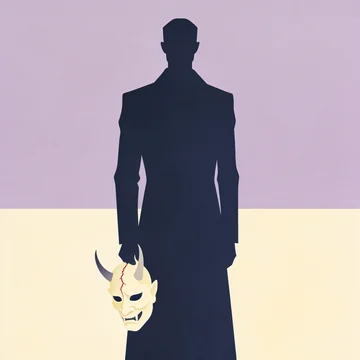
He carried with him in a lacquered leather case that had ridden through fifteen cities and three wars, the forty-five scripts out of the great Hana-za canon, each annotated in his cramped shorthand in three colours of ink. The paper had gone soft along the fore-edge where a thumb had opened it ten thousand times. staging notes laid over staging notes like sediment, the margins crowded with rooms he had not yet found and audiences he had not yet gathered. And at the very bottom of the case, under all of it, wrapped in a square of plain cotton, the Hannya mask.
The mask had amber eyes when worn. It had been carved from a single piece of aged cedar by a Yokai-theatre craftsman whose name no one had kept, and it came to Ren twelve years before this account begins, from a dying actor in a Naka no Umi port who pressed it into his hands with the terrible generosity of a man handing on what he can no longer carry.
The room where he received it smelled of camphor and finished business. The old actor’s hands, folding the cotton back from the carved amber-eyed face, were steadier than his breathing. “I played every role there is,” he told Ren, “and this is the only one that ever played me back. It will know you. That is not a comfort. Do it the courtesy of being someone worth knowing.” He was dead before the tide turned, the mask already across the room in Ren’s case, as though it had finished moving house and seen no reason to wait on the formalities.
“It does one thing,” the man had said, “and it does it at a price, and the price is the only part of it worth learning. Put it on when the audience needs to feel a thing before it is permitted to understand what it is feeling. And count what it costs you. Every time. Even the times when you feel it costs you nothing.” He had said that last part twice.
✦
Back on the rooftop, with the street below still held in the silence the lamp had bought: because a director who watches only his ensemble has already missed half the play, he looked down into the canal quarter, where one young Samurai Masters soldier stood perfectly still in the middle of the churn. He was neither flinching nor reaching for his blade, and he was watching the lit silk with the flat, gathering attentiveness of a man committing to memory a thing he fully intends to use.
Seventeen, perhaps. Gold eyes, which were not a common thing. He held himself with the infuriating certainty of someone who has already decided what he is and finds the world’s failure to agree mildly, briefly interesting.
Ren looked at him a long moment. A director looks at a great many faces across a life, most of them for as long as the scene requires and never again. He looked at this one for longer than the scene required.
Interesting, he thought. His pulse had picked up and he noted that it had, which was not a thing that happened to him in a street. Finally.
I.4 — THE GHOST
Drowned Shinobi field manual: the Stillwater Hold. Drop the body’s tempo beneath the room’s, the breath first, then the pulse, then the small unconscious motions the living never notice they are making — until the eye, which hunts only for movement, files you with the furniture and passes on. Held correctly it is not hiding. It is subtraction. Stand in the open and become a thing the room has already finished looking at.
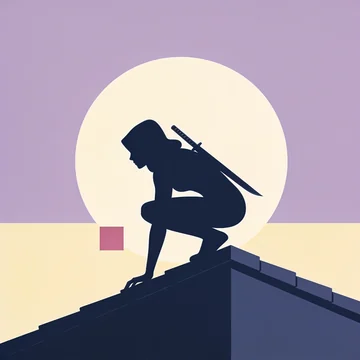
She moved through Ikazuchi’s camp at dusk. Finding the available space, occupying it without announcement, leaving no impression of her passing. The Submerge Step. The Shadow-Cutter, who had taken the title of Hanzo as the Drowned Shinobi’s oldest living master, grey-haired and river-calm and in possession of a blade the doctrine held could sever a shadow before it reached the body, had taught it to her in the river shallows at dawn with the patience of someone who had taught it four hundred times and knew that the body learns it before the mind does. The technique treats air the way water treats gaps, he had said. You are not hiding. You are simply being where you already are, without the noise most people make about being somewhere. She had practiced it until the stillness was bone-deep.
She stopped near a cookfire where three ashigaru were eating and talking low, the way tired men talk when they have decided the day is over. She sat. She accepted the bowl of rice someone pushed toward her without being asked, and she ate, and she listened.
What they talked about, low, over the rice, was the east. Not the battle behind them. The one in front, the one that had been taken from them before they could march to it. One of the three had a cousin who had gone to the eastern domains two winters back with a garrison relief and had written twice and then stopped, and the man said, in the flat voice soldiers keep for the things that have frightened them past the reach of a joke, that the stopping was the news. They spoke of the poison king the way farmers speak of a blight that has jumped a river: not an enemy you fight but a weather you flee. A mist that came up the valleys and left the villages standing, and the people in them smiling, and wrong. It did not kill a place, the youngest one said. He had heard it kept one. The oldest told him to eat and stop repeating what he did not understand, which Oboro heard as the thing men say when they understand a thing too well to want it said aloud. She catalogued all of it. The Realm was afraid of two things that season and had sent its armies against only one of them, and the one it had chosen to fight was the smaller.
Somewhere in the middle of it she said, to nobody in particular, that she had heard the eastern relief had been stood down twice.
It was not true. She had assembled it on the walk over, out of the shape of a thing a supply clerk might plausibly have half-heard, and she offered it to the fire rather than to any of them.
The guild taught it in one line and she had never found a better one: the fastest way into a closed man is a wrong fact, offered sideways, to nobody. He will not answer a question. He cannot leave an error standing. She had never seen it fail and had stopped, some years ago, finding it interesting.
The youngest corrected her at once, at length, and with the particular heat of a man who has been waiting some days for anybody at all to be wrong about this within his hearing. He told her it had not been stood down. He told her what had happened instead, and who had done it, and on which morning, and what had been said in the chamber afterward; and the two older men let him get most of the way through it before they began improving on him, which took another quarter of an hour and produced three details the young one had not known.
She said “Ah,” once, in the correct place. It bought her four minutes of a conversation none of the three would ever remember having.
She had been sent to observe. The contract, Fang Clan payment, the same network she had worked through for eleven years, no identifying information from the client, was incomplete. The target field was blank. She was here to gather information before deciding whether the contract was worth accepting.
The anger in Ikazuchi’s camp was not manufactured. These were Samurai Masters soldiers who had sharpened their blades for the eastern campaign, calculated the honour and the Kami Court’s favour that would come from beating the Yokai Poison King, and had it taken by an old man’s vanity. The anger was real, and it ran deep, and it had the quality Oboro had learned to recognise. The anger of people who were right.
She catalogued the camp’s layout from the cookfire without appearing to look at anything. She was good at this. She had been good at it since she was fifteen, when her handlers first could see what they had in her, and she first knew what they had done to her, and she had decided, in the cold-eyed way of a girl who had already survived things that would have destroyed someone with less control of her own face, that the understanding would stay private until it became useful.
Invisible was the one thing she had ever been that she learned to love, and not because she was invisible by nature. By nature, or so she had been told, in the years before the river and the rope and the three minutes underneath that had rearranged her relationship with most things, nature included, she had been a girl who wanted very badly to be seen. To be noticed. To have her existence acknowledged by someone other than the people whose job it was to acknowledge her.
She was thirty years old. Her name was Oboro, and the Drowned Shinobi’s records had taken to calling her the Ghost, a designation she had neither chosen nor objected to.
She had trained under Hanzo four years. She did not know whether he was still alive. The Drowned Shinobi did not maintain contact between assignments. This was doctrine. She followed it, even on the nights when following it felt like something other than discipline.
Across the camp, an officer’s tent flickered with lamplight.
She had already identified which tent was Ikazuchi’s. The one with two guards facing outward instead of in. A detail that told her everything she needed to know about how the man thought. He was not afraid of what was inside his own camp. He was afraid of what was coming from outside it.
To be overlooked, she thought, watching the guards watch the horizon and never once look at the woman sitting quietly at the cookfire in the exact middle of their sight lines, is to be underestimated. And to be underestimated is to be unstoppable.
She finished her rice. She handed the bowl back. She did not say thank you, because the woman who was here as a supply officer’s clerk would not say thank you to an ashigaru’s cookfire. She would simply hand back the bowl, bow and walk away. Which is what she did.
She had a blank target field and a camp full of information.
II.7 — THE FOX
Ledger: eleven strikes in four seconds. The name says one thousand. Names round up. Ledgers do not.
The kenbu games ran for nine days, twice a year, and Gōen’s dōjō had produced three successive champions. That was why Gōen could borrow against projected receipts, and why the debt never quite resolved.
Fox attended every bout. The arena held four thousand on a full day and was full for the sixth and ninth: a tiered stadium of packed earth and timber built around a sand floor, with its own barrier walls, betting galleries, and a security detail large enough to need its own rotation schedule. He sat in the accounts section at the northeast corner, the angle that gave the fullest view of the sand while appearing to be about ledger work. The sand was raked coarse for grip and it got into everything above the second tier, so that an afternoon in that arena followed you home in your cuffs for two days. He watched with the quality of attention that looked like indifference.
The nine days had a shape, and Gōen had built the shape the way he built everything: for the takings. The first day was banners and drums and the parade of fighters in borrowed finery, and the announcer, who was new that season and not at all what the arena was used to. Gōen had let his old crier go, a barrel-chested man with a voice that could crack plaster, and hired in his place, off a travelling company that had wintered in the district, a slight man of no particular age in a worn navy robe, who did not bellow. Not once across the nine days did he lift his voice to the pitch the old crier had lived at.
He did the reverse: he let the arena come to him, giving a name and then leaving a silence exactly one beat too long, so that four thousand people leaned forward into it to be certain they had heard, and by the time he had finished the title they were already his, already quieter than a fighting crowd has any business being, already, though not a soul among them could have said so, an audience and no longer a mob.
The middle days were grudge matches and debt bouts and novices being taught in public what the sand cost. By the sixth day the stands smelled of torch oil and skewer smoke and spilled plum wine, the odds-runners worked the tiers like gulls working a harbour, and the evening bouts ran under lamplight, because Gōen had learned years ago that darkness improved both the spectacle and the wagering. By the ninth, the whole district had rearranged itself around the arena the way a river town rearranges itself around a flood: everything closed, everything crowded, everything downstream.
Gōen presided from his box like a man conducting weather. He had a showman’s gift that he otherwise kept folded away under the accounting: the delayed matchup, the withheld name, the pause before the crier’s announcement stretched as long as four thousand people could bear it. Fox, who despised waste, entered a grudging professional note in the private column that season. The man wasted nothing. Not even cruelty. Especially not that.
He had a proverb for new fighters, delivered in their first week, before the crowds had got at them. Fox heard him give it four times that season in identical words: too much attention makes a donkey believe it is a lion.
He said it warmly, and he said it while selling tickets to that transformation, and Fox, who catalogued every contradiction the compound produced, put this one at the top of the list and left it there for eleven years.
The dōjō’s fighters were organised by the records he managed: sixteen kenbu on full contract, eight on assessment contracts, four slaves whose status he had noted in the accounts as assets, non-transferable without clan approval, which was as accurate a description of a slave as the Samurai Masters administrative language permitted. Of these, he had identified nine worth watching and three worth planning around.
The first was Jiyū no Kenshi, the Free Sword, which was a name and not a name: kenbu names were chosen for the crowd, and this one had been given by an arena announcer five years ago and had simply stuck. His real name, which he no longer used in Gōen’s compound, had been something else in a language Fox did not speak but had spent two months partially reconstructing from context. Jiyū was from the Naka no Umi coast, sun-browned and golden-eyed, with a loose mane of tawny hair and the trained economy of a man who had been fighting since before he was old enough to have been fighting, and who had somehow come out of all of it grinning. He used a style that had no official name in the Samurai Masters tradition because it had not been developed in the Samurai Masters tradition; it had been developed in harbour back-alleys and fishing-boat disputes and the kind of violence that was improvised rather than trained. He was small and fast and systematically underestimated by opponents who noted his height before his eyes, and his eyes were the thing worth noting.
Fox had watched him fight seven bouts over two seasons. He had not lost one.
The second was Tetsu no Shishō, the Iron Master — his own coinage, confirmed by the announcer because the crowd liked it. A broad, grey-haired man of perhaps fifty, who moved like a siege instrument: deliberate, inescapable, without urgency, because he had determined early in his career that urgency was a variable his opponents brought and he simply needed not to share it. He had been a weapons-smith before a debt brought him to Gōen’s compound, and the quality of his attention to an opponent’s technique had the same precision he had once applied to blade-tempering. He took in the structure of violence the way a craftsman understands material, from the inside out. He had lost two bouts in seven years. Fox had obtained the records of those losses and found, on close reading, that both were explicable: one against a fighter who had been permitted to use prohibited techniques for the entertainment value, one against Hōki in a training bout that Gōen had not sanctioned and then had declined to record.
Tetsu had not mentioned this. Fox knew because the accounting anomaly, a training-session fee that did not appear in the fighter roster, had told him before any person did.
The third was Hibana no Ōkami, the Spark Wolf, Takane-born, wolf-spirit bonded, and in the opinion of everyone in Gōen’s dōjō approximately twelve years old. She was nineteen. She was small and she looked younger than she was, and the wolf-bond had not taken her face the way Hōki’s lion-bond had taken his. Instead it sat in her like a current, manifesting when she chose it as a crackling charge that ran from her shoulders to her fingertips and earthed itself through anything she held or touched. That was the bond at rest. Electricity was an imprecise word for what the wolf-spirit produced. It was more specific than that: it was the feeling, in the body of an opponent who made contact with her in the wrong moment, that the ground had made a decision and they were no longer part of it.
She had joined Gōen’s compound eighteen months ago under a contract that said assessment and had never been updated to full, because Gōen had decided that keeping her technically unclassified gave him flexibility over her deployment that a full contract would complicate. Fox had identified this as a legal position Gōen found useful and Hibana found offensive, and which would eventually create an exit opportunity for someone paying attention.
She came to the accounts room about it once, in Fox’s third month, and he had all of it from four feet away with his brush moving and his face arranged into the blankness of a man doing sums.
“Full contract,” she said.
“Assessment contract,” Gōen said, “is a courtesy, and I would like you to hear the word properly before you spend the afternoon being angry at me. You came off a mountain with no clan behind you and no papers in front of you and a bond in you that two of my physicians declined to write down. I asked you nothing. You have eaten every day since.”
“Eighteen months.”
“And a very good eighteen months. There is no complaint anywhere in you. I have said so in rooms you were not in, which is the only place it counts.”
“Then classify me.”
Gōen set his cup down with the unhurried warmth that had carried him through fifteen years of creditors. “Assessment gives me flexibility.”
“It gives you me,” Hibana said.
There was a pause of about the length it takes a man to decide he is not going to be drawn, and then Gōen laughed, and the laugh was genuine, which Fox recorded as the most dangerous thing in the room. “Next season,” he said.
“You said next season last season.”
“And I meant it on both occasions. Seasons come round, child. That is their entire trick.”
Fox priced the exchange while it was still running. Gōen had not refused her. A refusal is an event; events have dates, and a date is a thing a person can stand on and argue from. He had deferred her, which is not an event, cannot be argued from, costs nothing, and can be done again at the same price indefinitely. It was, Fox thought, an extremely good piece of work, and he would have admired it without reservation if he had not been nineteen years old and carrying, in a boot he never took off, a phrase a surveyor had written about him at nine: talent asset, cultural management. The box is not accurate. He had said that sentence out loud once in his life, in a north-facing room, and it had bought him a five-year contract. She had just said it and been told about seasons.
The wolf-charge came up her arms then, once, blue and quick, and earthed itself through the door frame on her way out with a crack like a green log going in a fire. Gōen had the scorch painted over inside the week. He never mentioned it, and neither did she, and Fox walked past the patch every morning for four months and priced it a little higher each time.
A fourth name belonged on Fox’s list for reasons that had nothing to do with escape routes, and it was the announcer’s, though the announcer had given none and Fox had not yet run it down by other means. He kept the entry anyway, in the part of the ledger where he kept things he did not yet have a use for: a man who could make four thousand people go quiet by declining to shout at them; who watched the fighters between his own announcements the way a buyer watches stock he has already decided to bid on; and who was, Fox was nearly certain, not actually employed in the trade he was so plainly expert at. Fox did not know what he was. He knew only that the man was reading the same arena Fox was reading, for a reason Fox could not yet name, and that two men performing the identical act of attention in the identical room will, whatever their intentions, eventually have business with each other.
On the seventh day the announcer did the thing the district would still be describing a year later, because Gōen had handed him something no arena in the Realm had ever been licensed to present, and instead of shouting it he lowered his voice until the stands went quiet to catch it. “On the seventh day,” he said, and waited, “the House keeps a promise the House was frightened to make. By dispensation of the Kami Court, purchased, notarised, and chained twice for the road, it brings you a thing that has been kept in the dark three hundred years for the crime of seeing too much. It has a hundred eyes. It has never closed all of them at the same time. It is looking at you now.” He let that sit until someone in the low tiers laughed the wrong kind of laugh, and did not go on until the laugh had died of its own accord. “And standing in front of it, alone, for the House of Gōen: Mori no Yōshi. Count its eyes. Count his two. The House has already priced the difference, and reminds you, gently, that the House is rarely wrong about a number.”
✦
Mori no Yōshi fought only once that season, on the seventh day, and the dōjō management had not expected him to survive the bout, which was the entire point of scheduling it: Gōen had purchased, at considerable expense and through channels that did not appear in any account Fox was permitted to see, the temporary release of a yokai the Kami Court kept chained in a shrine annex two districts over. Hyakume, the Watching Dark, imprisoned for a crime the shrine records described only as observed too much, and told what it saw. The crowd had paid to see it fed a man. Fox had come to see what actually happened, which was, in his experience, reliably a different thing.
It came out of its palanquin the way the shrine wardens had warned the arena staff it would: slowly, and already looking at everyone. Bald, hunched, heavier through the shoulders than any man built to that height had a right to be, its pale skin unbroken by eyes only in the places skin usually shows none, the pattern relentless rather than random, cheek and collarbone and the backs of both hands each carrying their own small constellation, one eye larger than the rest sitting where a sternum should have sat, open and unblinking and the same wet grey as all the others. It did not walk into the sand so much as arrive there, the way weather arrives, and the four thousand people who had paid to watch it eat a man went, for the length of one held breath, entirely silent. The silence of a crowd realising, a half-second too late, what it had actually purchased.
Mori no Yōshi was broad rather than tall, with the stillness of men who had learned early that size invited a fight they had not chosen the terms of, and the bear-spirit bond showed in him the way Hibana’s wolf-bond showed in her: banked, not worn, a weight in the shoulders rather than a shape on the face. He said nothing before the bout. He said nothing during the parts of it that could be talked through.
Hyakume opened the engagement the way a hundred eyes open an engagement: everywhere at once. It came across the sand on all fours at a speed its bulk did not advertise, and where Mori set his feet a heartbeat later there should have been four separate strikes landing from four separate angles, both taloned hands, the weight of the shoulder behind them, and a low tearing bite the shrine records had never thought to mention, because the men who wrote the shrine records had never gotten close enough to need the detail. What arrived instead was a wall.
Kekkai no Yoroi, the spirit armour, the bear-bond’s oldest petition, a technique Fox had read about in a border-clan manual and never expected to see performed correctly. It did not strike outward so much as declare a boundary and dare the world to argue with it, and the Takane lore held that it answered only at the wrong arithmetic: one bear, a hundred coming. The bond did not lend its wall to fair fights. At even odds the petitioner was only a man; the old bear-clans taught that this was not a limit but the entire meaning of the technique, that the armour existed for the moment past hope, and would not cheapen itself on any other. Gōen, who had bought a hundred-eyed horror to feed one man to, had met the condition without ever knowing it existed.
Hyakume tested the boundary as it had tested three centuries of them: patiently, and from every direction it could produce. It circled. It came low, then high, then low again, a hundred eyes reading the wall for the one degree of give a hundred eyes would eventually find in anything built by a single, tiring man. Twice it found an angle that looked, from the stands, like an opening, and twice the wall was already there before the claws arrived, because Mori no Yōshi was not defending a shape. He was defending a boundary, and a boundary has no angles for a hundred eyes to prefer. The eyes could not find a seam. They tried for the better part of a minute, patient in the way of a thing that had watched for centuries and had never needed to hurry, and found none.
Then Mori no Yōshi stopped defending the boundary and became, instead, the reason it existed.
Senju no Kobushi, the thousand fists, was not a thousand strikes; Fox counted, because Fox counted everything, and the true number across the engagement’s final four seconds was eleven, but the name had never been about the count. It was about what the eleven felt like from inside a hundred eyes that had never had to plan for the possibility of being hit back. The first two took the shoulders and turned the whole heavy mass of it a half-step off its base. The third and fourth found the ribs before the shape had finished correcting for the first two. By the seventh, Hyakume was not fighting a man; it was trying, with a hundred eyes and none of them fast enough anymore, to simply locate one, and the last four landed in the gap that failure opened, each blow arriving in the space its own last flinch had vacated, an argument conducted at a speed the Watching Dark’s ancient patience had no answer for. Hyakume went down into something that was not quite a shape and was, by the time the arena surgeons reached it, not quite anything: a heap of stilled eyes on bloodied sand, most of them, in the last moment anyone thought to look, still open. The shrine wardens who came to collect what remained of their prisoner filed a report Fox later obtained a copy of, which described the outcome in four words: the boundary held; contained.
Mori no Yōshi did not acknowledge the crowd. He walked back to the fighters’ section, sat down three places from Tetsu, and said nothing to anyone for the rest of the day.
Fox added his name to the ledger under a heading of its own. Not asset, not investment, a category he had not needed before this bout and would not need again for some time: quiet, and correct about it.
✦
The third-day bout was the only one that season to end in a body carried off the sand rather than helped: Homura no Ittō, fire-bonded, his spirit-mark running molten along both forearms, against Mizuchi no Ha, a lean water-bonded fighter from the delta towns. They opened at range, a fan of dragon-fire met by a coil of called river-water, the collision throwing a wall of screaming steam across the front rows, and Fox saw the exchange before the steam had cleared: the ranged casting was reconnaissance, not commitment, each of them measuring how much of the other’s reserve a single working cost. When they drew blades and closed the rest of it on foot, the fight’s real shape was already set. Mizuchi found his one opening in the eleventh exchange, took a shallow cut to the forearm to buy it, and answered under Homura’s guard with a strike that carried the last of his water behind the blade, a thing that hit like steel and tore like a levee giving way.
Homura went down with a wound the arena surgeon pronounced unsurvivable before he had finished kneeling beside it, the fire guttering out of his forearms from white-orange down to the ordinary brown of unbonded skin, as if the bond left first and took the rest of him after. Gōen, from his box, looked less troubled by the death than by the fact that it had happened to the fighter he had money on. Fox recorded the bout under its correct heading, loss: capital asset, unrecoverable, and beneath it, in the notation only he could read: the ranged casting is reconnaissance. The blade is always the actual argument. Remember this. He would use the observation twice more in his life, in rooms considerably larger than this one, and both times it would be correct.
✦
There was a second entry that season, longer, written across four pages of the private column and never discarded. Every deciding technique he had now catalogued, the bear’s boundary, the committed water-strike, the full wolf-current he had not yet seen but could read in Hibana like pressure in a sealed jar, obeyed a rule that no manual stated as a law: the greater the art, the narrower its door. Each one was gated. By odds, by ground, by tide, by guilt, by an offering made in advance, by a commitment that could not be faked in the moment and could not be prepared in it either. A power that could be used at any time was, by that measure, a small power. The arts that decided battles could each be played once, through conditions that cost years to assemble, at a price collected on the far side. The old arena men had two words for the pattern, and they spoke them with the respect they otherwise reserved for debts: Shōri no Daishō. Victory’s price, paid in advance, at the door. Fox did not believe in doctrines. He believed in patterns that held across independent cases, which was what other people meant by doctrine when they were being honest. He filed the law. He would spend the rest of his life watching it collect.
✦
“Ninth day,” he said, “and the championship of the season, which means the House will now attempt to take back in one bout everything it has paid out across the other eight.” A ripple of laughter; he rode it, and let it fall. “From the games of the Naka no Umi, undefeated on three coasts, nineteen stone of the Samurai Masters’ own wrestling tradition: Kaigan no Kujira. The Whale of the Coast. When he takes hold of a man, three coasts agree, the man is already finished; he has merely not yet been informed.” He let the Whale have the roar, all of it, unhurried, and only when it began to tire did he spend the other half of what he had been saving. “And for the House. Small. Fast.” A beat. “Inexplicably still alive. Jiyū no Kenshi, the Free Sword. The odds are posted, and they are cruel, and the House reminds you, as it reminds you every year, that the House set them, and that the House has watched this small man make fools of better arithmetic than yours.”
The Whale was the largest man Fox had seen that year, and he moved the way the confident large moved: like a tide coming in, unhurried, cutting the sand into quarters and closing the corners, certain that space itself was on his side because it always had been. Jiyū gave ground in half-steps, reading him, the grin arriving early, which Fox had learned was not bravado but method. An opponent who is being smiled at makes one of two errors, and Jiyū had built a career on both.
The second minute nearly ended it. The Whale caught him, one wrist and the back of the neck, the clinch that had folded forty men on three coasts, and the crowd came up off its benches in a single animal movement as Jiyū went airborne. And then failed to be where the throw finished. He had gone with the force early, stolen the arc of it, and paid the theft off with a bounce across the sand that would have broken a stiffer man’s ribs. He came up bleeding from one ear, still grinning. The grin had changed registers. The crowd, which knew the difference, went quiet in the way arenas go quiet when the entertainment becomes the event.
Then Jiyū did the thing the assumption said no small man does: he stepped in. Inside the reach, inside the tide, making the distance so short that only small, fast techniques remained available to either of them, and he was considerably better at small, fast techniques than someone who had spent years learning large, slow ones. The third minute produced a throw Fox had never seen before, a re-angling of the opponent’s own forward momentum, using the ground as a wall and the opponent’s weight as the force, that dropped the Whale onto his back with a sound like a tree coming down, and the crowd received it with the noise that arrives when something has happened that they did not know was possible until it was already complete.
The Whale got up. That was what made him the Whale; forty men on three coasts had not. The fourth and fifth minutes were the true championship: the big man wiser now, elbows tucked, weight honest, hunting the clinch like a debt collector; Jiyū spending everything the harbour back-alleys had ever taught him, the flat palm off the ear, the heel behind the knee, the shoulder that arrived half a beat ahead of its own feint. Twice the Whale touched him. Twice the touch closed on the place Jiyū had been.
In the sixth minute the second throw came off the memory of the first. The Whale flinched from a re-angling he had already met once, and the flinch, not the throw, was the technique’s true target. Jiyū took the arm as the weight went by and finished it on the sand, with a lock the wrestling tradition had a name for and no answer to from underneath. The Whale slapped the sand twice, which is the coast’s way of saying enough, and Jiyū released him at once and pulled him up by the same arm, and the arena, four thousand strong, made more noise than it had made for the hundred-eyed horror. A monster is a spectacle. A champion is a possession. The crowd had just watched its own get up off the sand one more time than the visitor, and there is no louder sound in the world.
Gōen stood in his box and let them roar, and Fox could read him at eighty paces: he was already pricing next season.
The visiting fighter was helped off the sand, which took four men, and was received by the man himself with professional equanimity.
Jiyū walked back to the fighters’ section without looking at the crowd.
Three rows away, Tetsu had been watching the bout with the expression Fox had come to associate with him: the careful attention of a man evaluating technique and finding it instructive. He made a small note on the cloth-strip he kept for this purpose. He did not applaud. Fox had observed that Tetsu never applauded. He appeared to consider this a form of commentary.
✦
In the holding area, Hibana was waiting for the next scheduled bout with her hands flat on her knees, the wolf-charge running faint and blue at her wrists, visible from where Fox sat. She appeared to be thinking. She appeared to be thinking about the same thing Fox was thinking about.
Which was: the door.
Not the arena’s public gates; those were a stadium’s worth of problem, patrolled in numbers that made the question academic. The one that mattered was the fighters’ service complex behind the eastern stands, the low walled yard where Gōen’s compound connected to the arena proper, small enough that Fox could hold it entire in his head at once. There were four guards on its east gate. Three on the west. The north wall had a blind angle at its second corner that the rotation schedule left unobserved for forty-two seconds twice per hour, which Fox had established by counting. The south gate was the training entrance; it had two guards and a crossbar that required a key Gōen kept on his person, or a bar-lifting tool, or a sufficiently motivated application of force by someone for whom force was a professional capability.
He had been thinking about this for four months.
He thought, too, about what the nine days had actually been, underneath the takings. Four thousand people had spent them watching the most dangerous collection of fighters in the Realm and had seen entertainment. Fox had seen a command structure, idling, waiting for a war to request it. The board outside the betting house ranked half of the coming years by odds, and did not know what it was pricing. Nobody prices the flood at the flood’s own festival.
He added Hibana to the list he had not written down and carried only in the instrument his grandmother’s people had believed was worth more than any weapon: the mind that sees before it moves.
II.13 — THE FOX
Ledger: ten thousand in the column, three thousand on the ridge. The creek, correctly asked, is worth the difference.
The Battle of Fushi no Yama happened on the eleventh day after the escape from Tetsu no Machi, and Fox had been designing it for four months. Behind the ridge he had chosen, the Undying Mountain rose white and perfect and indifferent above the tree line, the one fixed point in the Realm that no army had ever managed to own, and Fox had picked his ground in its shadow on purpose: a garrison commander who has spent his career reading maps does not expect the mountain itself to be part of the argument.
On the night before the column came, Hōki walked the fire lines.
He did not give the speech generals gave. He stopped at each fire, and at the last one, where the youngest fighters sat pretending they had slept the night before a battle before, he stood in the light and let them look at the lion’s face until they stopped needing to.
“They will tell you,” he said, “that tomorrow decides whether you are free. They are wrong. You decided that already — in the sand, at the south gate, on the mountain road, the night you stopped asking permission to exist. Tomorrow decides nothing. Tomorrow is only the day the Samurai Masters find out.” He looked down the slope toward the dark line of the southern road. “So sleep, if you can. And if you cannot, sharpen. Either way, make it a bad morning for the men who priced you.”
Fox, at the edge of the firelight, made no note. He had modelled the camp to hold four minutes past first fear. He revised the figure upward to six and said nothing, because some corrections were pleasures.
The battle happened as drawn.
✦
Zanpai no Taishō was the first field-commissioner Edo sent against Hōki, and he had the confidence of a man who had never lost to anyone the House of Daimyo considered worth counting: young for the rank, immaculately turned out even on campaign, the kind of officer who had risen by executing the manual precisely rather than by ever needing to depart from it. He viewed the assignment, put down an uprising of arena property before it became embarrassing, as the fast route to a second star, and had said as much, according to the report Fox had bought off a supply clerk, at a dinner the week before he marched.
His Samurai Masters force came up the southern road in column: good discipline, good equipment, completely wrong for the terrain, which Fox had confirmed through three Fang Clan contacts who moved through the Fushi no Yama area at will. Fox had positioned the Hybrid Warriors fighters on the high ground three hours before the column arrived.
He had chosen the ground for specific reasons that he had written out in precise order, not because he needed the list but because the act of writing forced him to see the assumptions buried in the logic.
The creek-crossing was compromised first. Fox had spent two nights with three Fang Clan tracker-shamans mapping the root systems beneath the southern bank, and one additional night explaining, in terms the shamans found interesting or insulting, the gap between those two things being unclear across the language barrier, that he did not need them to fight. Only to ask the roots.
The Rootbind Curse, the Fang Clan called it. The technique by which a forest that had been properly petitioned would hold what it was asked to hold. Fox had read about it in three different source texts and had approached all three with the same provisional respect he gave any methodology that produced consistent results across decades of independent practice. Whether the roots were responding to a spirit negotiation or to something else entirely was a question for scholars. The creek-crossing needed to fail. The creek-crossing failed.
And the creek was only the final page. For three nights before the column arrived, Fox had edited the terrain the way he edited ledgers: quietly, in the margins, where a reader’s eye is trained not to go. The obvious ford was seeded with tetsubishi under two inches of silt, so that the horses would favour the deeper crossing where the roots were waiting. The goat path up the western slope, the one route a flanking officer would congratulate himself for spotting, ran beneath three deadfalls rigged to a single horsehair line. The dry gully offering the column’s rear its natural shelter had been undercut along forty feet of bank, wanting only the weight of sheltering men to become a grave with a view. None of it was designed to kill in quantity. Traps, Fox had told the fighters who dug them, are not weapons. They are sentences in the enemy commander’s mind. Each one says: the ground has been thinking about you. By the fourth such sentence an officer stops trusting the earth he stands on, and a column that does not trust the ground moves at half speed and thinks at a quarter.
Zanpai’s officers learned, one lesson at a time, that the battlefield had been edited. Then they reached the creek, where the last editor was waiting.
✦
And on the high ground above the creek, with the column arrayed bright and disciplined below him and his own three thousand standing in a silence Fox had asked them to keep until this exact moment, Hōki walked to the lip of the ridge where every eye, theirs and the enemy’s, could find him, and did not draw his blade.
“LOOK AT THEM!” he called, and the mountain caught his voice and hurled it down the line. “Ten thousand men who have never met a thing they could not cage, and they have dragged their chains all the way up my mountain to prove it. Chains! For us!” A sound moved beneath the words, low, not quite language, and the front ranks felt it in their teeth. “They came up this road certain they were the hunters. Before the sun is high they are going to learn, all together, in one voice, that they are the meat.”
The lion’s face swept the ranks, and where it passed, men bared their own teeth back at it.
“They penned you and called you beasts. They bled you in the sand and called you beasts. GOOD.” The word landed like a dropped blade. “Then be the beast. Be the thing they were right to be afraid of. Everything standing between you and the rest of your lives is standing, right now, at the bottom of this hill, and it is afraid.”
There was a boy in the third rank who had come out of Gōen’s compound eleven weeks earlier and had, in his life to that morning, been spoken to as a person perhaps four times. Fox asked him later what he had heard. He said he had not heard any of it. What he had was the first thought that had ever arrived in his own voice instead of somebody else’s, and the thought was: he is talking to me. He was nineteen. He went up the ridge in the front rank at dawn and came back down it alive, and he was still telling it forty years later to anyone who would sit still for him, and he never once got the words right, and it never once mattered.
“Today. We hunt.”
He lifted his head.
And Hōki called the roar.
It was not a shout. A shout is a man, and what came out of him was older than men: the thing the divine lion had left banked in his blood, a sound with a floor under it, a pressure in the chest, the noise the world had made in the dark before anyone taught it manners. And along the ridge every bonded throat tore itself open to answer: wolf and bear and lion and the nameless bonds between them, three thousand voices falling into the one note that lived beneath all of them, until the note was no longer voices at all but weather, and it rolled down the slope and over the creek and broke across the column like a wave finding a wall.
Fox, who did not believe in omens, watched the enemy horses’ ears go flat a full two hundred paces before the sound reached them, and quietly revised a number he had thought was already generous.
✦
Down at the water, Zanpai’s veterans heard, for the first time in their disciplined lives, a sound their training held no answer for: the sound of property that had decided, all at once and out loud, to stop being property.
Then the day’s work began.
The Samurai Masters cavalry reached the crossing at the fourth hour.
The southern bank rose.
Not dramatically; not the way it appeared in the martial ghost stories Fox had dismissed as entertainment rather than doctrine. The roots came up through the mud with the patience of things that had been underground for decades and had simply been asked to stop being so. They came through the horses’ hooves first, lattice-work pressing up through the packed creek bed, and the horses understood before their riders did. Every horse at the crossing understood simultaneously and simultaneously refused to be at the crossing any longer. The column’s front third became a problem of terrified cavalry in confined ground, and the rest of the column had nowhere to go because the road behind was occupied by the rest of the column, and the high ground was occupied by people who had chosen it specifically for this moment.
From his position above the tree line, Fox watched the column fold on itself.
It was almost as he had modelled it.
The Hybrid Warriors on the high ground began their descent.
Fox had spent nine days, and four months of dirt-floor practice before them, organising the Hybrid Warriors’ foot soldiers into something that was not a Samurai Masters army, he did not have the numbers or the training for that, but that understood three things: hold the high ground, maintain formation for as long as the formation was useful, and trust the plan in the first four minutes before fear could revise it. They held. They came down the slope with spears and with the ferocity of people who had spent months being told they were not capable of winning and had chosen to resolve that question experimentally.
The Samurai Masters column was disciplined. Fox had known it would be. Discipline in bad terrain against a force that had chosen the terrain was a different kind of discipline: the discipline of dying in order while uncertain whether any of it was working. They reformed around the cavalry confusion. They elevated shields. They were doing what their training had prepared them to do, and it was almost enough.
Fox watched. He adjusted two positions via runner. He noted three places where his model had been optimistic.
✦
Ledger: a model that survives contact is a good model. A model that survives what came through the tree line was never a model. It was a wish with numbers on it.
Then Hibana came through the tree line on the column’s right flank.
She was running.
She was nineteen years old and she looked twelve and she had been running since she was eight years old from things that had wanted to hurt her for reasons that had nothing to do with her and everything to do with what she was, and the wolf-spirit in her had absorbed every year of that running and had opinions about what happened when it finally stopped. She ran toward the Samurai Masters shield line with her arms out at her sides, and the wolf-charge, the electrical current the bond produced that imprecise word did nothing to describe, ran ahead of her like a river that had reached the edge of something and remembered it could fall.
And as she ran, the bond stopped being a current and became a shape. The mane came first, red and gold, breaking out along her shoulders like fire discovering a new material. Then the wolf’s head rose through her own: muzzle, fangs, eyes like struck copper, the Oni-wolf putting on the available edges of a nineteen-year-old girl the way a soldier puts on armour. What reached the shield line was not someone who looked twelve. What reached the shield line was the reason the arena announcers had called her the Undefeated, and had said it quietly.
The war-shape had its own gate. The Takane singers state it as a vow, not a rule: the wolf rises for the pack, never for the wolf, and it spends the body that carries it, every minute of the shape borrowed out of her own heartbeat, at interest. She had chosen her minute with three thousand of her people committed down the slope behind her, which was the only kind of minute the shape would answer.
It hit the shield line at both ends simultaneously.
The men holding those shields were holding metal-banded wood. Metal conducted what the wolf-spirit produced. The feeling, in the body of a man holding a metal object when the current earthed itself through it, was that the ground had made a decision about you. The shields went sideways. The men holding them went down, not dead, mostly, but gone from the equation, which was enough, and the gaps opened in the line the way locks open when someone removes what is holding them.
The Hybrid Warriors came through the gaps.
What happened inside the broken formation was chaos of numbers. It was the arithmetic of spears in a crowd: men pushed onto points by the weight of their own rear ranks, the wounded going under the feet of the living, the creek running first pink and then frankly red where the cavalry had drowned in their armour among the roots. A man next to the standard lost his arm at the shoulder to a wood-axe and stood looking at the space where it had been with an expression of polite inquiry before he sat down and did not get up. The sound was the part the ballads never kept: not clash and cry but a vast wet grinding, under a canopy of screaming horses.
Fox watched the shape of it from the ridge.
✦
This was the moment he had been drawing in the dirt for four months: the geometry of a force that could not be contained by the response it encountered, cascading through positions that had been designed to hold something else. The model had been close. The model had not included Hibana in the right place.
He made a note.
Then Hōki descended the southern ridge, and Fox discovered that there was another variable he had not included in his model correctly.
The Rage Unbound.
The Hybrid Warriors’ name for it: the moment when the lion-spirit bond stopped being dormant and started being itself. Fox had read about this in theoretical texts. He had seen it once before, at the kenbu arena. The difference between the arena and the battlefield was the difference between a controlled environment demonstrating a principle and the principle arriving in the only context that had ever been its natural home.
What descended the ridge was not a man moving down a slope. It was something that had been held in place too long arriving at the first thing in its path. The Samurai Masters column at the creek was simply what was there.
The markings on Hōki’s arms were past amber, past the white-edged intensity Fox had seen in the arena; they were burning, the lion-spirit fully present, fully committed, the yokai tracery turned to something that had no colour name in the administrative vocabulary of the Samurai Masters. The black mane was full across his shoulders. The amber eyes were gold and past gold.
He came through what remained of the column’s centre without slowing.
The centre’s second cohort did the correct thing, the manuals’ thing: shields interlocked, spears set in double rank, the braced hedge that had stopped every charge in the Samurai Masters’ textbook of charges. The Rage did not charge it. It arrived at it, which was different, and took the first rank’s shields the way a storm takes shutters, not through them, out of their owners’ hands, upward and gone, and then the hedge was forty men holding spears against something already inside the spears’ length. The cohort’s standard-bearer, to his lasting and recorded credit, planted his feet. Hōki took the standard, and the man came with it for the first half-turn, and then the standard alone swept the second rank off its footing like a boom coming across a deck, and what remained of the centre stopped being a formation and became a decision that four hundred men made individually, all at once.
The soldiers in his path made the choice every sensible person made.
The ones who did not make it fast enough were moved. Fox observed, from the ridge, the quality of being moved by something operating above the normal register of violence: not clean, not quick, not the efficient lethality of technique meeting technique. The Rage Unbound was not technique. It was the force behind all technique, stripped of its management. A man caught in its path was a man caught in what combat actually was underneath its forms and traditions, and the forms and traditions provided no insulation.
Three men dead at the creek crossing. Fox counted, later, from the reports. The number was lower than he had feared.
The column broke.
Not all at once; columns broke in pieces, the rear moving before the front fully understood, the front collapsing before the rear had made its decision. What Fox watched from the ridge was the sequential failure of a structure that had been built for different conditions, unit by unit finding itself unable to hold what had been asked of it and making the same rational calculation.
They ran south. The road they had come up was the road they went back down, and they went down it fast, and the Hybrid Warriors fighters let them go because Fox had been clear about this in the briefing: running men were not dead men and dead men were not captured positions, and what they needed was the territory, not the bodies.
Among what the column left behind on the mountain: Zanpai’s warhorse, a white stallion with campaign ribbons still braided into his mane, found standing at the abandoned command position with the perfect unconcern of an aristocrat whose staff had unaccountably stepped out. The field-commissioner himself went south on a requisitioned supply mule, a detail Edo’s ballads declined to mention and the mountain’s never left out. Hōki rode the white from that morning on. He called him Karite, the Borrowed One, and when one of his captains asked why, he said: “Because everything the Realm ever handed us was borrowed, and the interest was our lives. This one, I am keeping the interest.”
Afterward: celebration, fire, noise, euphoria.
✦
Fox walked the long way to the camp’s edge, straight through the middle of it. What victory did was take the lid off. The camp smelled of woodsmoke and spilled drink and, under both, unmistakably, of sex. It was happening at the fire-edges, and in the dark lanes between the tents, and once, without apology, against the very supply cart he had meant to inspect, two fighters who had not troubled with a tent and did not stop, or so much as look up, when his shadow crossed them. Fear had held these people in one closed fist for long. The fist had opened this afternoon, all at once, and what came out of it was appetite of every kind, ungoverned and loud. He filed it without disapproval, because disapproval was not a column his ledger kept; he filed it as data. A body that has spent a year certain it will die does not celebrate survival quietly, and an army in that state is, for one night, incapable of discipline and just as incapable of fear, which were two facts a commander on the other side would pay a great deal to own and would time his morning around. He noted the hour it would burn off and kept it, against a morning that might need spending.
Fox sat alone at the camp’s edge and reviewed his notes.
He identified three variables he had underestimated. Hibana’s range: the wolf-current had earthed itself farther along the shield line than his model had predicted, which suggested either a stronger bond than the assessment records indicated or a condition-dependent amplification he hadn’t seen at the kenbu dōjō. He added this to the model as directionally important.
The Rootbind Curse had worked in the conditions the shamans had described and in no others; it had failed entirely at the upper creek, where the root system was younger and shallower. He noted: terrain petitions require soil assessment in advance. Not battlefield spiritualism. Logistics.
And the Rage Unbound. He had modelled it as a force multiplier with high variance. The variance was higher than he had modelled. What it produced at the column’s centre was not countable in any ordinary military terms; it had not simply engaged the soldiers there, it had dissolved the assumption that the column was a coherent structure, and the dissolution had propagated outward faster than any runner he had sent could have managed.
He ate his meal. He let himself remember his grandmother, who had died when he was fifteen and who had never told him he was exceptional. She believed that telling someone they were exceptional was the most reliable method of making them worse at things.
He believed she was right.
He added one final note: The bond cannot be predicted precisely. Build for it. Do not pretend it is not real.
He closed one further question that week, in the private column: the node that reported in two directions. He had promised Hōki a name when he was certain, and he was certain by the third day: a relay position in the courier chain, not a fighter; a man who carried honestly for the rebellion and carried again, one remove later, for a paymaster he had likely never met. Fox did not remove him. A known leak is an instrument. For the rest of the campaign the two-directions node carried, at intervals of Fox’s choosing, what Fox wished the other direction to believe, and twice that winter a garrison marched to answer an army that did not exist. Hōki got the name the same evening, and the harder instruction that came with it: leave him in place, and feed him.
What Fox could not close, what he filed under errors in model, unresolved, and returned to at intervals for twenty years, were two patterns above the node; and for most of his life he was satisfied they were one pattern seen from two angles, which is the kind of economy a good mind performs on itself without noticing.
The first was money. Somewhere over the network sat a buyer whose appetite he could read in its consequences: grain positions taken early, suppression contracts priced the same week the House began to argue them, a hand already in the market before the market had been given its reason.
The second was timing, and it was worse, and he never resolved it at all.
Not early. Before. Contracts priced before the House had voted them; in one instance, which he checked four times across nine years because he did not believe his own copy, before the motion had been drafted. Appetite can be read. Appetite spends, and spending leaves arithmetic, and arithmetic can be walked backward to a man. What he could not walk backward was a channel that never appeared to carry anything, and that appeared, on every occasion he examined it, simply to have had the thing already.
He had one name out of that season and never made anything of it. A supply clerk at the northern hub, asked where a particular routing instruction had come from, said that a travelling scholar had been through in the spring, had taken an interest in the arrears tables, and had said something about them that the clerk had repeated later to two people because it was the only interesting thing anybody had said to him that year. The clerk gave the name as Shinen no Ro. Fox entered it, and cross-referenced it once, and found a Zen Circle scholar of that name at an academy four provinces off with no business anywhere near a grain hub, and closed the entry as a coincidence of names, which is what it looked like, and what it may still have been.
He looked for it for the rest of his life. In the last year of the private column, in a hand that had begun to go, he wrote five words and no comment: the grain is still wrong.
He put the name back on the sheet twice more across the years and struck it out both times. Shinen no Rō. A Zen Circle scholar of no particular distinction at an academy four provinces from anywhere that mattered, and Fox could establish that the man had been alive, and had travelled, and had once sat some years on a panel of examiners, and nothing whatever beyond that. He filed him, in the end, under the heading he kept for things that were almost certainly nothing and could not be made to go away: *coincidence, third instance.*